

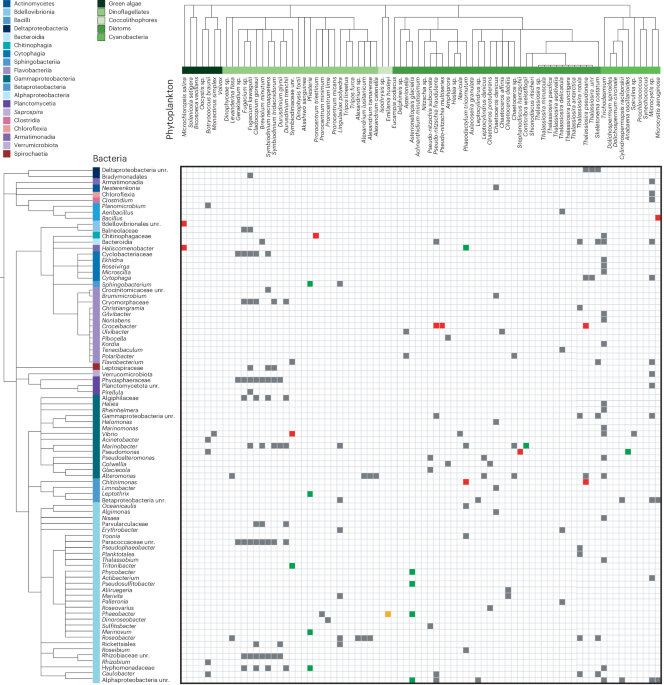
Phytoplankton are responsible for approximately half of Earth’s net primary production and, together with heterotrophic bacteria—the main consumers of organic matter—play a pivotal role in biogeochemical cycles. Their key ecological importance has led to growing interest in the interactions between these two groups. Yet, our understanding of the microscale mechanisms driving these interactions remains limited. Recent work highlighted the contribution of bacterial motility and chemotaxis to promoting encounters and nutrient exchange between bacteria and phytoplankton. In contrast, the ecological role of bacterial attachment—an important adaptation enabling bacteria to establish the closest contact with their phytoplankton host and retain it over extended periods of time—remains less explored. Here we describe the current evidence and understanding of bacterial attachment to phytoplankton and highlight recent insights from single-cell studies. Motivated by the implications for large-scale ecosystem processes, we discuss promising research avenues to further unveil the ecological relevance of bacterial attachment to phytoplankton. Here the authors review current understanding of the mechanistic marine microbial interactions that underpin large-scale ecosystem processes and biogeochemical cycling. Buchan, A., LeCleir, G. R., Gulvik, C. A. & González, J. M. Master recyclers: features and functions of bacteria associated with phytoplankton blooms. Nat. Rev. Microbiol. 12, 686–698 (2014). Strom, S. L. Microbial ecology of ocean biogeochemistry: a... [22243 chars]


2026 Copyright © News-Matic.com. All Rights Reserved