

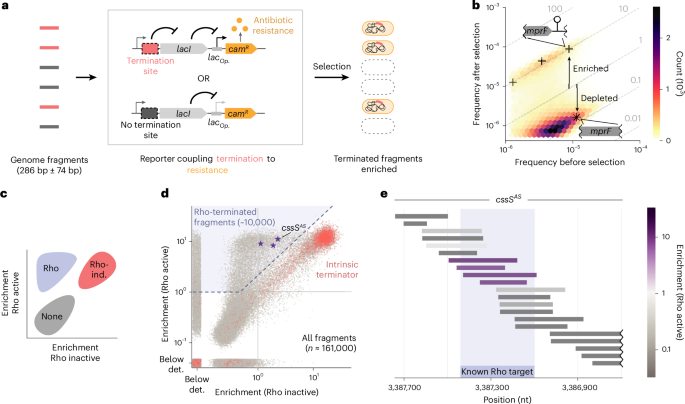
Genes in many bacteria are rich in purine nucleotides (A and G), but the origin of this preference is unclear. Here, using a large-scale reporter assay in Bacillus subtilis, we show that this purine bias is critical for gene expression. It prevents premature transcription termination in species that exhibit runaway transcription, in which RNA polymerases outpace ribosomes, leaving nascent mRNA exposed to the termination factor Rho. This vulnerability is resolved by a divergence between Rho’s heightened target specificity and coding-strand nucleotide content. Selective pressure to avoid Rho appears to drive strong gene purine bias across species that exhibit runaway transcription, except in lineages that have lost Rho. This purine requirement underlies codon usage biases, promotes suppression of pyrimidine-rich antisense transcripts and can suppress expression of engineered constructs. Our results suggest that avoidance of premature transcription termination imposes major constraints on nucleotide content during genome evolution and adaptation of foreign genes. Purine bias is critical for gene expression in bacteria, preventing premature transcription in species that exhibit runaway transcription. Genome-wide mapping of Rho termination If sequence composition protects mRNA from Rho termination in B. subtilis, then isolated, untranslated fragments of coding sequence should not be terminated by Rho. To test this hypothesis, we designed a massive... [30235 chars]
ADVERTISEMENT



ADVERTISEMENT
2026 Copyright © News-Matic.com. All Rights Reserved