


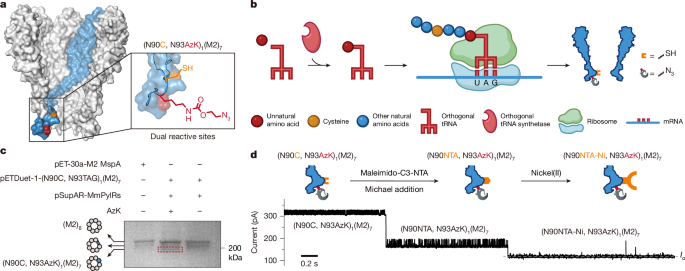
Accurate decoding of peptide sequences is crucial in proteomics. However, achieving this goal is a technical challenge, owing to the compositional and structural complexity of peptides1. Studies inspired by the success of nanopore nucleic acid sequencing have shown that nanopore-based techniques can also be applied to peptide sequencing2,3. The key is to generate narrowly distributed, consistent and sequence-dependent events during sequential nanopore readout. Here we introduce a nanopore-based strategy termed transient pore analyte looping (tPAL). We develop an engineered Mycobacterium smegmatis porin A (MspA) nanopore that is dual modified with a nickel-ion-bound nitrilotriacetic acid (NTA-Ni) adapter and the target peptide. This distinctive sensing configuration enables precise recognition of the N terminus of the immobilized peptide by multiple re-readings. With the aid of cholesterolized aminopeptidase, the immobilized peptide can be shortened sequentially in single-amino-acid increments, yielding sequence-dependent, stepwise and narrowly distributed signal alterations that provide clues to allow peptide sequence decoding. Our strategy achieves single-amino-acid resolution and effectively identifies single-amino-acid mutations, post-translational modifications and unnatural-amino-acid insertions—indicative of its versatility in nanopore proteomics and chiral peptide analyses. A nanopore-based ‘chop and measure’ method sequences peptides at single-amino-acid resolution by using enzymatic digestion to progressively shorten the N terminus one residue at a time, together with repetitive N-terminus re-reading. (a) The workflow of multi-voltage sweeping and machine learning. In brief, each peptide was measured using a multi-voltage (+60 mV, +100 mV and +140 mV) protocol to acquire its tPAL events. For each voltage, 200 events were collected per peptide to c... [10227 chars]

ADVERTISEMENT

ADVERTISEMENT
2026 Copyright © News-Matic.com. All Rights Reserved