


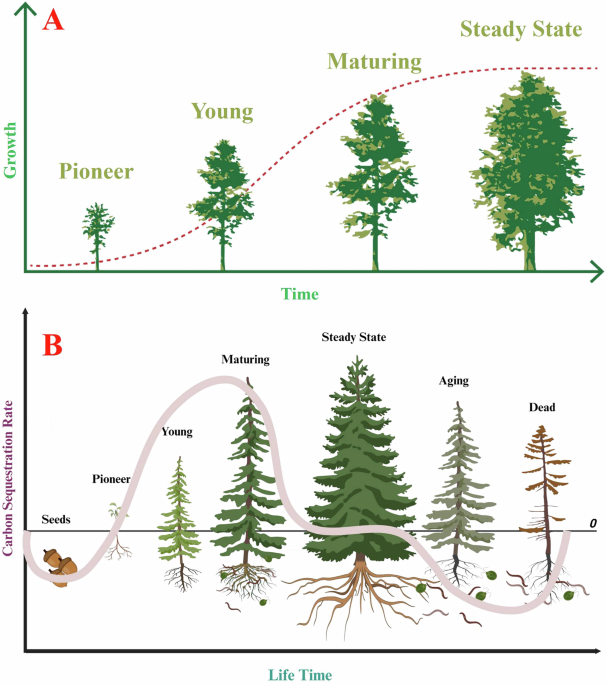
Forest-climate-economy relationships present critical challenges for climate mitigation in rapidly developing economies. While forests are traditionally viewed as carbon sinks, their effectiveness as tradable carbon products remains difficult to quantify in the near term due to time lags and scale mismatch with energy-driven emissions dynamics. This study examines these relationships in China using data from 30 provinces (from 2000 to 2019). Using LSTM-MLP hybrid models and multispatial Convergent Cross Mapping, we reveal what we term the “forest carbon paradox”: despite China’s extensive afforestation efforts increasing forest coverage significantly, these initiatives demonstrate limited immediate impact on CO₂ emissions and GDP trajectories. Energy consumption variables, particularly electricity and natural gas, consistently emerged as the dominant drivers of both emissions and economic growth, while forest coverage showed minimal predictive power in our models. Causal analysis revealed asymmetric relationships: CO₂ emissions strongly influenced forest coverage (0.88) versus weaker reverse effects (0.49), suggesting policy-driven afforestation responses rather than direct ecological feedback mechanisms. These findings highlight the need for paradigm shifts in forest carbon valuation strategies that account for temporal complexities in forest-economy-emissions relationships. Forests serve as primary carbon sinks and climate regulators in global environmental systems1. Since systematic monitoring began in the 1980s, forest ecosystems have undergone significant transformation, with old-growth carbon-rich forests increasing... [42172 chars]


2026 Copyright © News-Matic.com. All Rights Reserved