


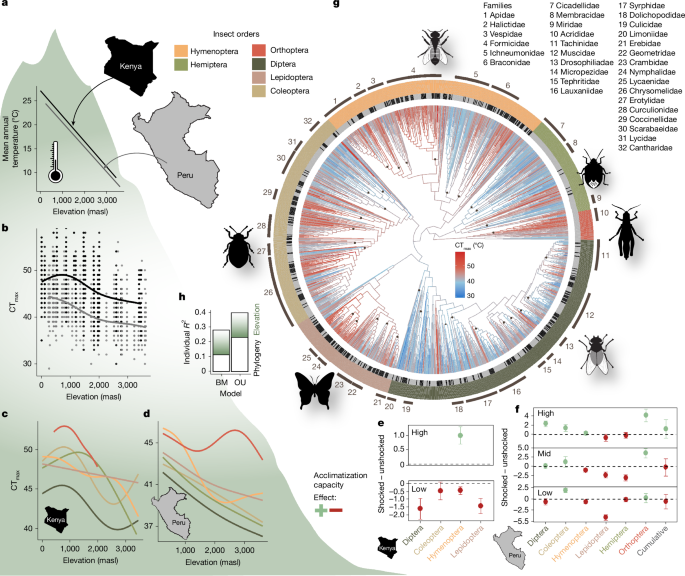
Insects make up the majority of all animal species, with 70% occurring in the tropics1, yet the impacts of warming on tropical insects remain highly uncertain2. This stems from sparse, taxonomically biased data on thermal tolerance of tropical insects and an incomplete understanding of the underlying physiological mechanisms3. Here we compared environmental temperatures with field-measured upper and lower thermal tolerance limits of around 2,300 insect species along Afrotropical and Neotropical elevational gradients and identified genomic signatures of thermal tolerance across the insect tree of life. We show that thermal tolerances do not proportionally track environmental temperatures but approach an asymptote in tropical lowlands. Insects at high elevations utilize plasticity to cope with rising temperatures, whereas lowland species have limited plastic abilities. Heat tolerance showed strong differences among insect orders and families, reflected in the thermal stability of proteins, suggesting that variation in thermal tolerance is founded in the fundamental protein architecture. Up to 52% of future surface temperatures and 38% of air temperatures in the Amazonian lowlands can cause heat mortality in half of the studied community. Our data suggest a limited capacity of insects in the Earth’s most biodiverse regions to buffer future warming. A survey of tropical insect populations and thermal tolerance limits indicates that species from lowland areas have low capacity to survive increased temperatures, and that thermal tolerance is limited by fundamental properties of protein architecture. Study area In Peru, the study was carried out along an elevational gradient from 245 masl to the tree line at 3,588 masl in the Andes of south-east Peru (Kosñipata valley), with continuous and mostly undisturbed wet rainforest/cloud forest. The clima... [22836 chars]


2026 Copyright © News-Matic.com. All Rights Reserved