


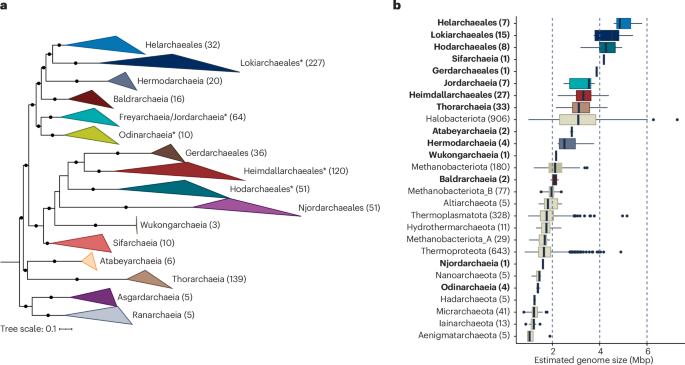
The Asgard archaea are a clade of archaea that was first discovered through metagenomic surveys of marine sediments. The past decade has witnessed a substantial expansion of their genomic diversity, revealing diverse metabolic repertoires and providing insights into their ecological interactions and function. Notably, comprehensive phylogenomic analyses, together with the identification of numerous eukaryotic signature proteins in Asgard archaeal genomes, have provided compelling evidence that Asgard archaea had a central role in the emergence of eukaryotes. Studies have reported the characterization of cultured Asgard archaeal representatives, uncovering unique cell biological characteristics hinting at thus far undescribed lifestyles. Here, we review the current state of the research field focusing on these intriguing microorganisms and outline future research directions aiming to resolve their ecology, cell biology and evolution. The Asgard archaea have become a cornerstone of archaeal research, particularly for studies aiming to unravel the origin and early evolution of eukaryotes. This Review outlines the current state of the research field focusing on these intriguing microorganisms and discusses future research directions aiming to resolve their diversity, ecology, cell biology and evolution. Woese, C. R. & Fox, G. E. Phylogenetic structure of the prokaryotic domain: the primary kingdoms. Proc. Natl Acad. Sci. USA 74, 5088–5090 (1977). Woese, C. R., Kandler, O. & Wheelis, M. L. Towards a natural system of organisms: proposal for the domai... [21254 chars]


2026 Copyright © News-Matic.com. All Rights Reserved