


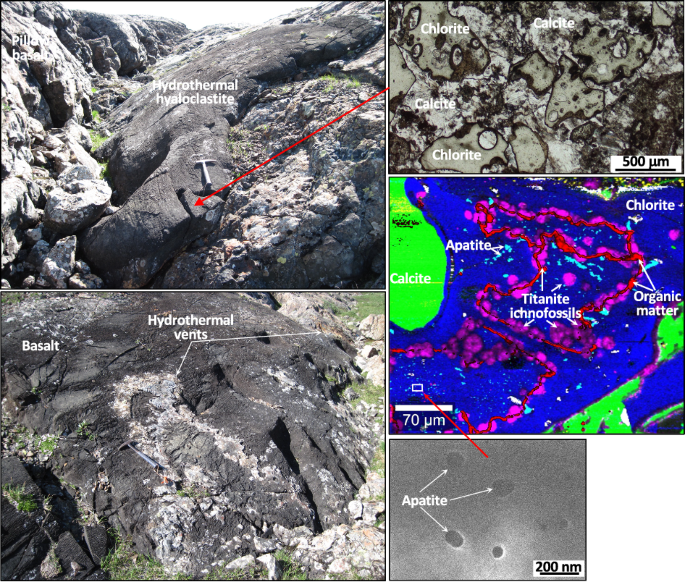
Ichnofossils in basaltic glass are putative microscopic trace fossils occurring on modern seafloor and throughout Earth history. While their biological origin remains debated, it is unknown why microorganisms thrive in volcanic glass. Here we show ichnofossils associated with biosignatures from sedimentary interbeds of pillow basalt in the ~ 1870 million years old Flaherty Formation, Belcher Group, Canada. These rocks are associated with metre-size, pinnacle-shaped structures of silicified basalt, pahoehoe basalt with paleo-caliche, and isolated pods of gossan indicating shallow marine hydrothermal venting. Trails of spheroidal ichnofossils composed of titanite and organic matter surround abundant nanoscopic-size apatite and lepidocrocite, suggesting they caused rock dissolution to obtain phosphate. Stable isotopes provide complementary biosignatures for possible chemolithotrophy. While there is evidence for abiotic carbon-based reactions, the biological origin of spheroidal ichnofossils is supported by 13C-depleted organic matter and calcite, suggesting they were burrowed by microorganisms likely seeking phosphate in volcanic glass near hydrothermal vents. Nearly 1,900 million years old hydrothermal vents have trace fossils and biosignatures suggesing the original microorganisms dissolved basaltic glass to obtain phosphate. Carbon and sulphur isotopes suggest they had a chemolithotrophic lifestyle. Djokic, T., Van Kranendonk, M. J., Campbell, K. A., Walter, M. R. & Ward, C. R. Earliest signs of life on land preserved in ca. 3.5 Ga hot spring deposits. Nat. Comm. 8, 15263 (2017). Wacey, D. et al. Geochemistry and nano-structure of a putative ~32... [8832 chars]


2026 Copyright © News-Matic.com. All Rights Reserved