


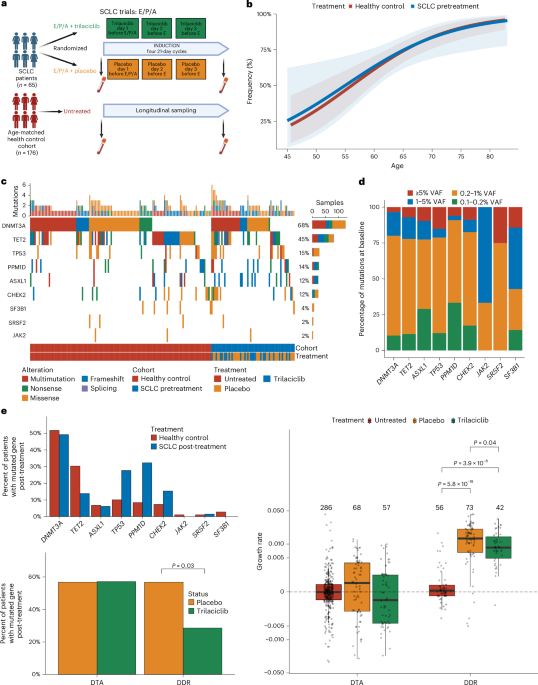
Therapy-related myeloid neoplasm (tMN) is a fatal consequence of exposure to cytotoxic therapy administered in the treatment of cancer. Individuals with pre-existing TP53 clonal hematopoiesis (CH) are at high risk of tMN, with avoidance of therapy being the only strategy to reduce tMN risk. Here, in four randomized clinical trials, we show that the CDK4/6 inhibitor trilaciclib, given in conjunction with a variety of chemotherapeutic regimens and across diverse populations of patients with cancer, mitigates chemotherapy-related expansion of CH clones with mutations in DNA damage response genes, including TP53. This finding was also observed in a syngeneic mouse model of TP53-mutant CH, demonstrating that CDK4/6 inhibition blocks platinum-induced TP53 competitive repopulation through promoting hematopoietic stem and progenitor quiescence and decreasing the stemness advantage of TP53-mutant clones. This represents a proof of concept for a potential pharmacologic strategy to block chemotherapy-induced expansion of preleukemic TP53-mutant clones. Analysis of clinical trial data suggests that CDK4/6 inhibitors prevent the expansion of TP53-mutant clones in the blood, potentially mitigating the risk of secondary myeloid neoplasms in patients treated with cytotoxic drugs. Trilaciclib reduces DDR CH expansion during chemotherapy We obtained serial blood samples from 65 individuals with ES-SCLC, pooled from two studies, undergoing first-line therapy with carboplatin and etoposide with or without atezolizumab who were ra... [41788 chars]


2026 Copyright © News-Matic.com. All Rights Reserved