

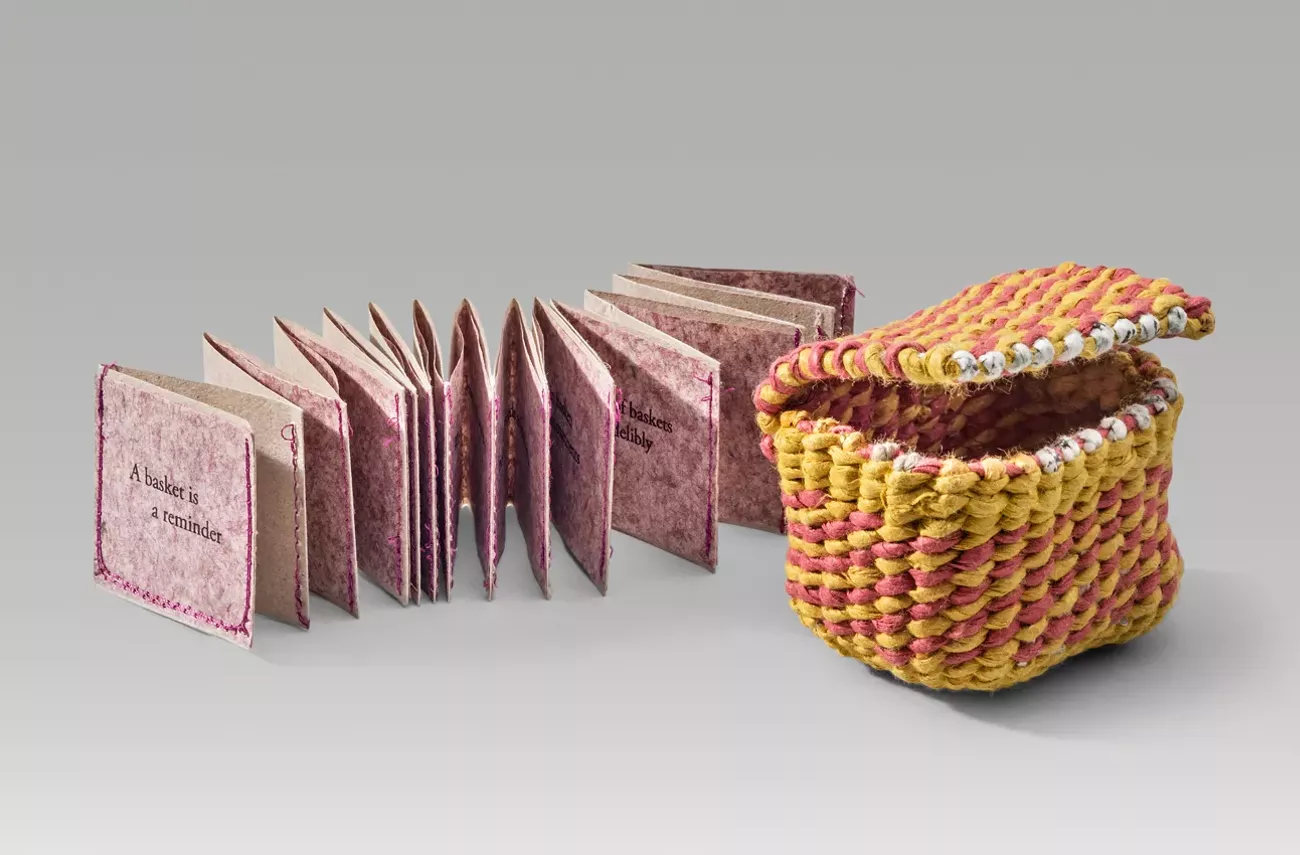
Aimee Lee Brings Korean Hanji to BIMA’s Artist Books Collection by Bess Lovejoy When Aimee Lee’s face pops up on my Zoom screen for our interview, her head is framed by something I can’t quite comprehend. It appears to be a tapestry of bricks. The bricks—persimmon-colored, cream, gray-blue—look somehow soft and light, as if molded from putty still wet and waiting to be touched.It’s paper. When it comes to Lee’s work, it’s always paper. But this paper is a far cry from the crisp stack of 8.5" x 11" that sits next to my printer. It’s paper that troubles the neat boundaries around that material, or at least the ones in my head. This is paper as fabric, paper as ceramic, paper as survival, paper as memory, paper as art.Specifically, this paper is hanji—Korean paper, made from a millennia-old, achingly laborious process that involves, in part, stripping the inner bark from the paper mulberry tree and mixing it with a mucilage often made from hibiscus roots. The reason anyone in the US knows how to do this is because of Aimee Lee; she wrote the book (literally). She opened up the first hanji studio in North America (in Cleveland, where she now lives). Her work will be on display in the Sherry Grover Gallery at the Bainbridge Island Museum of Art March 6 through June 14, where it appears in the form of artists’ books, clothing, baskets, and also ducks.BIMA’s collection of artist books is unique. Most artist books (more on what that form entails in a moment) are kept in academic institutions or special collections. But the collection of 4,000-plus artist books at BIMA, initially amassed by the museum’s founder, Cynthia Sears, is one of the largest in a museum, and a free museum at that. The gallery hosts three exhibitions a year of items drawn from their collection, as well as loaned objects—all usually small but vivid, often heartbreakingly personal and political.BIMA’s website explains that artist books “exist at the intersection of art, craft, and storytelling.” Erin Zona, the new curator of BIMA’s artist books collection, says: “The artist is using the language of the book, historically or abstractly, as the art form, as their material.” She adds that there’s often a narrative, time-based element: “I use the same parts of my brain when I’m looking at an artist book from page 1, 2, 3, 4 that I do when I’m in a cinematic experience.” Unlike, say, a painting, where the viewer’s eye might dart all around the work, in an artist book, the creator can control the journey and let the story unfurl according to their will.But the form is always challenging itself: An artist’s book might involve a long indigo scroll, a crown of thorns, a fortune cookie, a butterfly, a specimen cabinet, a piñata. The artists who make them often combine multiple disciplines, such as paper-making, sculpture, photography, fiber, drawing, or block printing. Aimee Lee says that during her undergrad at Oberlin, for example, for her final project she “sewed together a doll and then saved all my hair and tried to attach it and made like little organs that were separate from it. And that was my final book.”But eventually, Lee fell in love with paper. “What I love about paper is it really can mimic many different things,” she tells me. “Like you can make a sculpture out of just paper. And it looks exactly like a rock, you know? It can be this chameleon, and for me ... it just feels very much like my experience of growing up and feeling like unseen or invisible or underestimated.”Few would dare underestimate Lee now. But she came to her life’s work almost by accident. On a field trip to the campus museum at Oberlin, her class was shown a 17th-century Chinese scroll spattered with gold. The museum’s curator of Asian art said the scroll was probably painted on Korean paper, which Chinese artists of the time often preferred. That was the moment Lee’s life changed.“I just suddenly was like, what am I doing studying Chinese art? I don’t know anything about Korean art. And I’m American; up until then, I had a very typical second-gen experience being born in New York and really rejecting Koreanness,” she says.That fleeting reference to Korean paper sent her to a language program in Korea and, eventually, to graduate study in book arts and papermaking. But she quickly noticed that most mentions of Asian paper focused on Japanese styles, which had become dominant through colonization. Information about Korean hanji was harder to access, so she applied for a Fulbright and went to Korea to learn it herself.Getting that Fulbright turned out to be the easy part. The technique she wanted to learn was traditionally performed by men, and Lee was repeatedly turned away. “It’s not even just you’re a woman,” she recalls being told. “But you don’t look very strong.”Once a teacher finally agreed to take her on, the apprenticeship expanded into learning a whole constellation of crafts: paper basketry (jiseung), texturing and fusing techniques (joomchi), natural dyes, and calligraphy. Lee learned how Koreans had once used hanji to make armor, quivers, ammunition pouches, even chamber pots and teapots. She’s made some of those herself—yes, hanji can be watertight, thanks to heavy coats of rice paste and lacquer.Part of the reason hanji was put to so many uses is that it’s extraordinarily durable. (Think “survives for 1,000 years” durable.) Lee cites the long fibers of the paper mulberry tree, and the papermaking technique that layers the fibers at different angles to reinforce the material’s strength. That means hanji can bend, not break, when exposed to stress.Lee sees another metaphor in that resilience. “The things you can do to hanji reflect the Korean history in terms of the horrible things that have happened to people, just insane amounts of war and colonization ... and that just makes them stronger.”Something of that strength is reflected in the title of the BIMA show, Tethered. It comes from an On Being podcast with the former poet laureate Ada Limón, in which Limón talked about writing as a way to anchor yourself to the world. Lee, and former curator of the Cynthia Sears Artists’ Books Collection Catherine Alice Michaelis, liked the concept but preferred the word “tether” to the heavier “anchor.”“If I am handling this [material], it connects me to all the people who did this all the way back, you know, for thousands of years. It connects you to a human lineage,” Lee says.Zona also sees this kind of tethering in Lee’s meticulously crafted books and sculptures, dyed sky blue with indigo or juicy orange with the flower coreopsis.“We always think that we’re living kind of in the future or in some sort of space that’s not the same as somebody who lived a thousand years ago,” Zona says. “But through [Lee’s] work, there’s this connection to time and processes and the human experience.”That kind of connection, that tether, can feel especially good right now, and it’s part of why Zona and BIMA are committed to expanding access to the collection (parts of which can be viewed and touched in twice-a-month tours) and deepening its holdings. In the coming months, there will be a new publicly accessible database of the collection, a new video series on YouTube, and upcoming exhibitions on textile-based artworks and artist books created by Black artists.“I’ll speak for myself, [but] every single time I look at my phone or the newspaper or whatever, it’s just something else is happening. Like what acts of violence is our government conducting today?” Zona says. “Sometimes I try to kind of ground myself and root myself in terms of, you know, the sun is still shining in the exact same way that it did 1,000 years ago on a body that was just like mine. And so, there’s some sort of nurture that comes through in that, where it’s just, it kind of alleviates the pressure of the moment. And it’s just kind of this outlet to nurture ourselves and be present in our bodies, present in the planet, and, you know, related to the history of the world in a way that feels less stressful.”See Tethered: An Artist Talk with Aimee Lee March 14 at BIMA’s Frank Buxton Auditorium


2026 Copyright © News-Matic.com. All Rights Reserved