


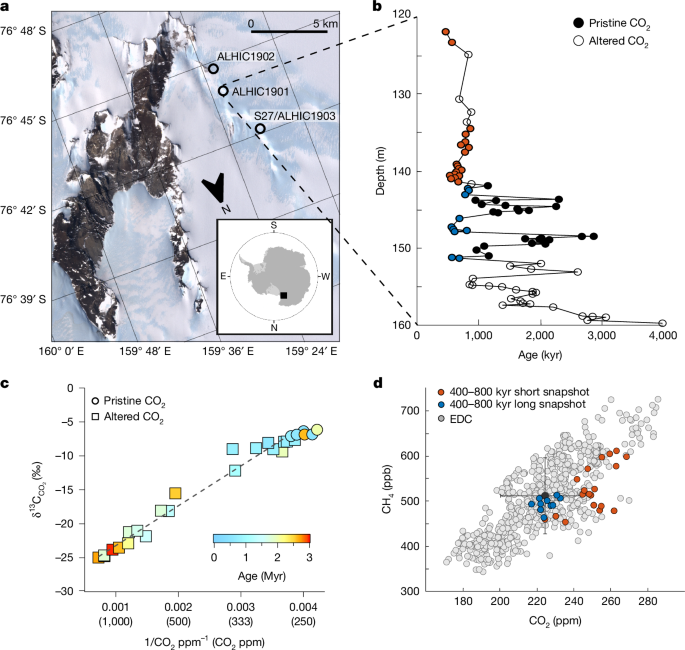
Ice core records from Antarctica document continuous variations in atmospheric greenhouse gases over the past 800,000 years, delineating the glacial–interglacial cycles that characterize the late Pleistocene epoch1–3. Studies of blue ice areas4 have extended these records back to 2 million years (Myr)5,6. The evolution of atmospheric greenhouse gases before this time thus remains uncertain. Here we use discontinuous ice core snapshots spanning 3.1–0.5 Myr ago (Ma) to show no marked change in mean methane (CH4) and a small decline of about 20 ppm in carbon dioxide (CO2) between 2.9 Ma and 1.2 Ma, followed by stable concentrations (±10 ppm) across the mid-Pleistocene Transition. Our findings are based on the shallow ice cores drilled in the Allan Hills Blue Ice Area (BIA), Antarctica7. The records are complicated by postdepositional processes and probably represent averages over glacial cycles weighted by climate-dependent differences in accumulation rates (which we assume to be constant). Samples aged 2.8–3.1 Myr, affected by respiration and corrected using stable carbon isotopes in CO2 (δ13C), yield mean atmospheric CO2 levels indistinguishable from the early Pleistocene (250 ± 10 ppm). Although palaeoclimate archives from Antarctic blue ice areas are complex, our records show that measurements of greenhouse gases in ice cores can be extended to the late Pliocene epoch, providing snapshots of Earth’s climate system over a time of global cooling7,8 and falling sea level9. Blue ice records from Antarctica are used to determine methane and carbon dioxide concentrations over the past 3 million years. Lüthi, D. et al. High-resolution carbon dioxide concentration record 650,000–800,000 years before present. Nature 453, 379–382 (2008). Bereiter, B. et al. Revision of the EPICA Dome C CO2 record from 800 to 600 kyr before present. Geophys. Res. Lett.... [14557 chars]


2026 Copyright © News-Matic.com. All Rights Reserved