


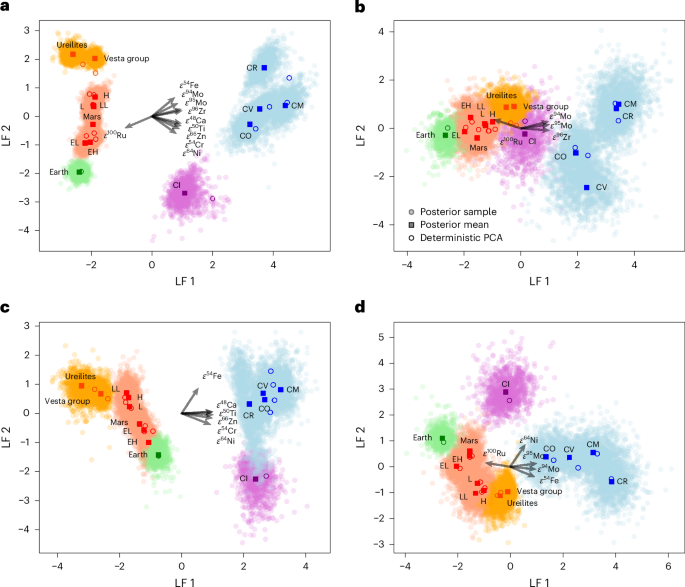
Meteorites are classified as either non-carbonaceous or carbonaceous, representing bodies that are likely to have formed in the inner or outer Solar System, respectively. Despite its location in the inner Solar System, the Earth is thought to contain either minor (~6%) or substantial amounts (~40%) of outer Solar System material. However, because neither interpretation leverages variations among multiple isotopic systems simultaneously, Earth’s provenance remains equivocal. Here we examine variations in ten nucleosynthetic isotope anomalies among planets and meteorite parent bodies to show that the linear extension of an array defined by non-carbonaceous bodies in any two isotopic anomalies always intersects the observed isotopic composition of the bulk silicate Earth to within 1 standard deviation. The Earth therefore formed exclusively from inner Solar System material whose composition did not vary over the course of accretion and was, on average, unlike that of any chondrite. Extension of the non-carbonaceous array yields isotopic compositions for Mercury and Venus that are more extreme than for Earth, implying a spatial or temporal gradient during the formation of the terrestrial planets. Earth’s origin is debated. Meteorites formed in the inner and outer Solar System, but Earth represents an endmember, inner Solar System source alone. Venus and Mercury are predicted to be more extreme, implying a gradient in the inner Solar System. The identification of two, distinct populations of meteorites from their mass-independent isotopic compositions1, the ‘isotopic dichotomy’, has precipitated a revolution in our understanding of the provenance of planetary materials and, in turn, the ... [35404 chars]


2026 Copyright © News-Matic.com. All Rights Reserved