


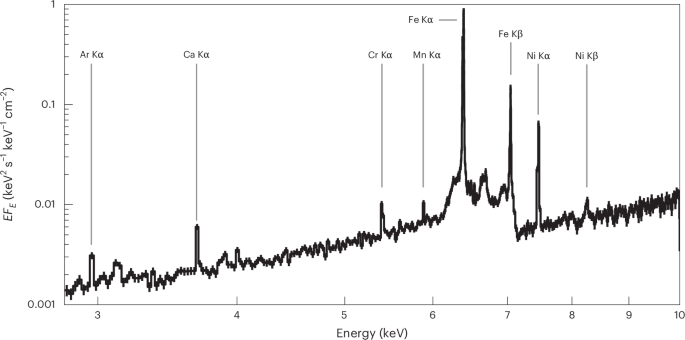
The metal abundances in galactic nuclei carry key information on the history of star formation and mass transfer in central regions of galaxies. X-ray fluorescence analysis is a unique tool to reliably measure the abundances of various elements via simple physics. Here we present a new observation of the active nucleus in the Circinus galaxy with the XRISM satellite at unprecedented X-ray energy resolution. The fluorescent iron Kα line profile modified by Compton scattering indicates that the material responsible for its emission is cold and metal rich and is located ≳0.024 pc from the supermassive black hole, consistent with the dusty torus region. The abundance pattern derived from comparing fluorescent line intensities of different metals shows subsolar ratios of argon- and calcium-to-iron and a supersolar ratio of nickel-to-iron. This abundance pattern is best produced by a combination in number fraction of $$9{2}_{-4}^{+2} \%$$ core-collapse supernovae from progenitor stars less massive than $$2{0}_{-2}^{+3\,}{M}_{\odot }$$ and $${8}_{-2}^{+4} \%$$ type Ia supernovae. This suggests that gas feeding the supermassive black hole was enriched by recent core-collapse supernovae. Our findings imply that in metal-rich environments stars more massive than about 20 M⊙ directly collapse into black holes or make faint supernovae without ejecting heavy metals into the space. XRISM spectroscopy of the nucleus of the Circinus galaxy indicates elemental abundances suggestive of a dominant enrichment from core-collapse supernovae with progenitors below 20 solar masses; more massive stars may directly collapse into black holes. The elemental abundance pattern is a crucial indicator for comprehending the history of metal production and supply in metal-enriched systems1. It reflects the history of past supernovae (SNe) of various types, roughly divided into type Ia SNe (SNe I... [49836 chars]


2026 Copyright © News-Matic.com. All Rights Reserved