


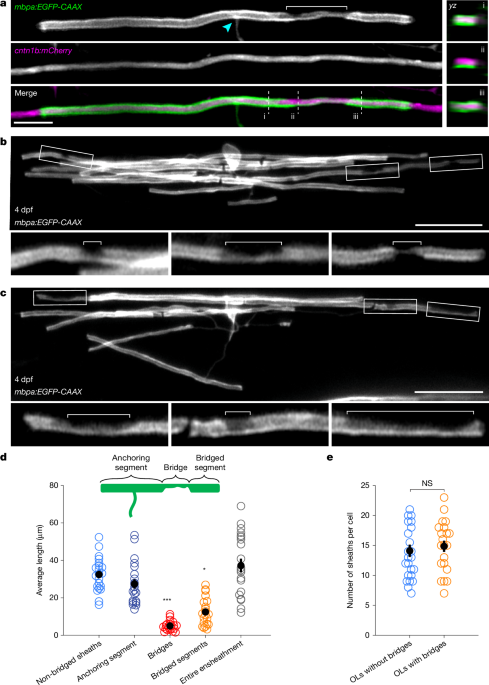
Myelin sheaths made by oligodendrocytes in the central nervous system (CNS) are critical to circuit function and neural health. The distribution of these insulating sheaths varies substantially between brain regions1, neuron subtypes2 and individual axons3–5, but the mechanisms that control this patterning are poorly understood. Although previous studies suggested that each oligodendrocyte process generates a single myelin sheath, this mode of axon ensheathment severely constrains myelination along highly branched axons within complex circuits6. Here we find that axon ensheathment by individual myelinating processes in zebrafish and mouse proceeds at different rates along axons. This enables a single oligodendrocyte process to extend past axon branch points and nodes of Ranvier before ensheathment, resulting in the formation of chains of myelin sheaths connected by thin cytoplasmic processes. In the cerebral cortex, these ‘paranodal bridges’ expand the myelin territory produced by individual oligodendrocytes along the highly branched axons of parvalbumin interneurons. Although flexible ensheathment reduces the need for oligodendrocytes, terminal sheaths in myelin chains degenerated more frequently in the aged brain, suggesting that they are more vulnerable to cellular and environmental stress and disproportionally contribute to myelin loss. The rate of axon ensheathment varies within individual myelinating processes, resulting in chains of myelin sheaths connected by bridges consisting of thin cytoplasmic processes that provide flexibility for myelination of highly branched axons. Zebrafish care and use Zebrafish were maintained in the Queen’s Medical Research Institute BVS Aquatics Facility at the University of Edinburgh with approval from the UK Home Office according to their regulations under the following project licences:... [21916 chars]


2026 Copyright © News-Matic.com. All Rights Reserved