


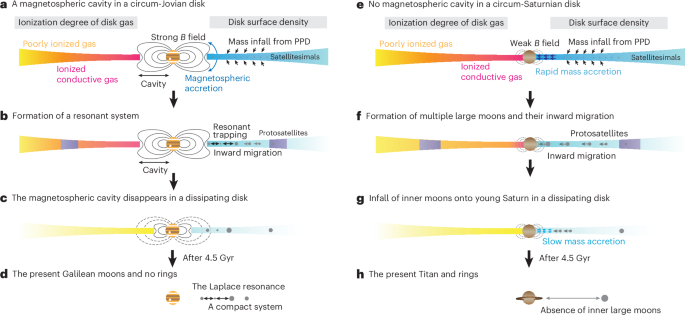
The Jovian system has four large moons, three of which are in the Laplace resonance, whereas the Saturnian system is dominated by one giant moon. What creates the difference is still a mystery. Here we show that the formation of a magnetospheric cavity in the circumplanetary disk around a young gas giant can explain the different orbital configurations of these two satellite systems. The strong surface magnetic field of Jupiter carves a cavity while the ionization degree of the disk gas remains high enough for magnetic coupling. By contrast, Saturn has too weak a surface magnetic field to open a cavity due to the narrow dynamo layer in its deep interior. Our N-body simulations show that Laplace resonance can form near the cavity and survive until the disk dissipates, but protosatellites in the circum-Saturnian disk fall onto the planet and only Titan, formed at a wide orbit, survives with the help of a ‘safety zone’. Our findings predict that compact exomoon systems, in cases of massive gas giants, and a couple of distant moons, in cases of Saturn-sized gas giants, will be found in future surveys. The difference between large satellite systems around Jupiter and Saturn can be explained by the feasibility of their magnetospheric accretion. This finding also provides insights for future exomoon surveys. Canup, R. M. & Ward, W. R. Formation of the Galilean satellites: conditions of accretion. Astron. J. 124, 3404–3423 (2002). Canup, R. M. & Ward, W. R. A common mass scaling for satellite systems of gaseous planets. Nature 441, 834–839 (2006). Mosquei... [10023 chars]


2026 Copyright © News-Matic.com. All Rights Reserved