

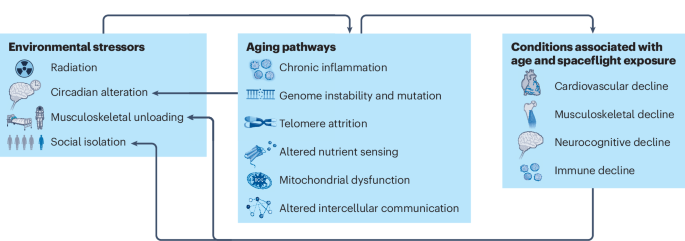
Aging is a complex biological and societal challenge, where modest advances can yield substantial clinical and economic benefits. While model organisms have uncovered key mechanisms of aging, their physiological relevance to humans remains limited. Astronauts offer a uniquely informative human model: despite being healthy and highly selected, they exhibit many hallmarks of aging and experience comparable declines in cardiovascular, musculoskeletal, cognitive and immune function—often on accelerated timelines. These changes are largely driven by four core exposures of the space environment: microgravity, circadian disruption, ionizing radiation and social isolation. Here, by tracing how environmental factors affect biological processes such as mitochondrial dysfunction, altered cytoskeletal dynamics, chronic inflammation and other canonical hallmarks of aging, we position spaceflight as a powerful model for human aging—one that unites environmental stress biology, multi-omic systems approaches and clinical research to advance both astronaut health and the healthspan of aging populations on Earth. Could astronauts serve as a unique model for human aging research? Manwaring-Mueller et al. review how spaceflight stressors, such as microgravity and radiation, accelerate biological aging pathways and could inform treatments for age-related diseases on Earth. López-Otín, C., Blasco, M. A., Partridge, L., Serrano, M. & Kroemer, G. Hallmarks of aging: an expanding universe. Cell https://doi.org/10.1016/j.cell.2022.11.001 (2023). Kelley, A. et al. National Institute on Aging’s 50th anniversary: advancing agi... [37780 chars]


2026 Copyright © News-Matic.com. All Rights Reserved