


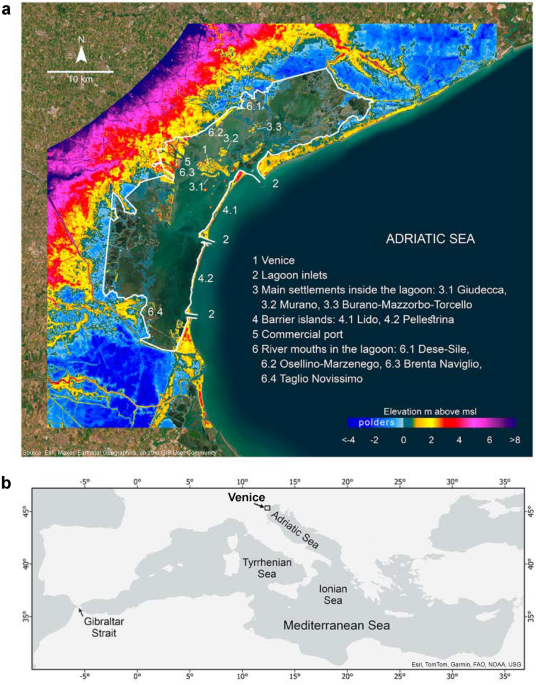
The substantial risks posed to Venice and its lagoon by ongoing and projected sea-level rise (SLR) require unprecedented long-term adaptation strategies. We map the evolution of development pathways and the progressive shrinking of the solution space as SLR advances, identifying adaptation tipping points and analysing the relative pros and cons of alternative measures. The analysis highlights trade-offs among environmental quality, heritage preservation, social well-being and relevant Sustainable Development Goals, and costs increasing with SLR. With present insufficient greenhouse gas mitigation policies, the current open lagoon strategy, with mobile barriers and multiple accommodation measures, is likely to encounter hard limits within the current century. Follow-up strategies include ring-dikes isolating the city from the rest of the lagoon, or a closed lagoon with permanent coastal dams, each preserving different combinations of values while entailing major ecological and socio-cultural transitions. Under extreme SLR, relocation of monuments to suitable inland areas and abandonment would be the only remaining strategy, which might become unavoidable in the 22nd century under current climate policies and an Antarctic ice-sheet collapse. Rapid mitigation could still avoid the most disruptive long-term outcomes. Adaptation strategies: suitabilities, limits and costs Based on the available knowledge and technologies, we consider four strategies to address the risks posed by SLR to Venice and its lagoon: open lagoon, ring-diking, closed lagoon and retreat, eac... [46475 chars]


2026 Copyright © News-Matic.com. All Rights Reserved