

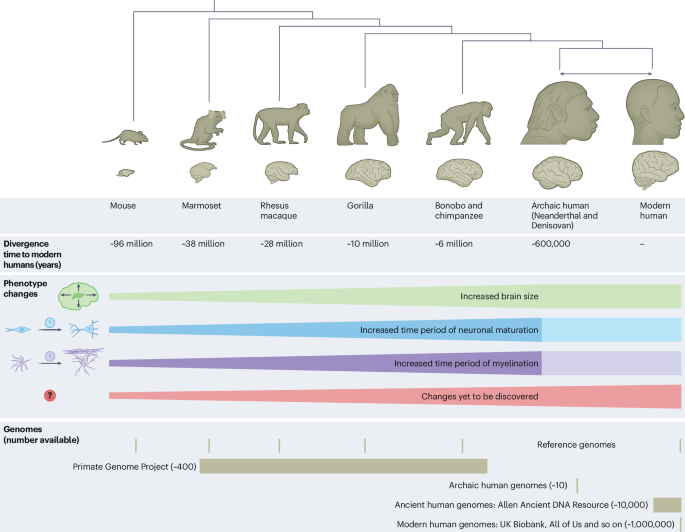
Human cognitive and social behaviors differ from those of other mammals, but the molecular, cellular and circuit-level changes that underlie these behavioral differences are poorly understood. The recent availability of thousands of mammalian, non-human primate, ancient human and modern human genomes now makes it possible to use quantitative approaches to identify genomic regions with signatures of selection in humans, which, when combined with comparative experimental approaches, can provide precise insights into the phenotypes that were the targets of adaptation across different evolutionary timescales. This Review presents a progress report on a ‘genome-up’ approach to understanding human brain evolution and lays out a framework for further advancement. Additional progress will require cohort expansion to improve the identification of genetic loci under selection, the application of comparative experimental approaches to additional milieus and the functional dissection of specific human-evolved loci. This Review describes how an approach that starts from genetic changes under selection during human evolution and integrates comparative and functional studies can reveal adaptive phenotypes across different evolutionary timescales. Nurk, S. et al. The complete sequence of a human genome. Science 376, 44–53 (2022). Christmas, M. J. et al. Evolutionary constraint and innovation across hundreds of placental mammals. Science 380, eabn3943 (2023). Kuderna, L. F. K. et al. A global c... [20356 chars]


2026 Copyright © News-Matic.com. All Rights Reserved