


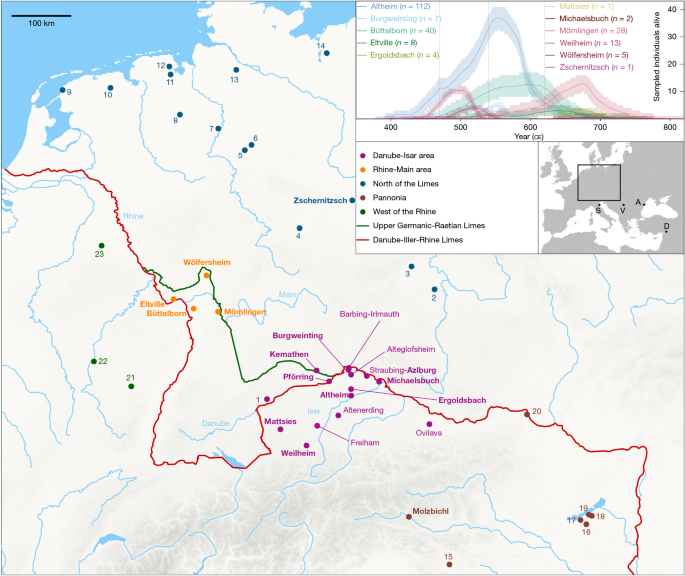
The emergence of new political and social structures in Western and Central Europe during the transition from Antiquity to the Middle Ages has long been attributed to large-scale migrations. Yet emerging evidence increasingly emphasizes the role of small-group mobility in reshaping the Roman world1–3. Here we present 258 ancient genomes from the former Roman frontier of southern Germany, which we analyse alongside 2,500 ancient and 379 modern genomes. Population genetic analyses reveal a major demographic shift coinciding with the late fifth century collapse of Roman state structures, when a founding population of northern European ancestry mixed with genetically diverse Roman provincial groups. Pedigree reconstruction and filia, a method for inferring the ancestry of unsampled relatives, indicate widespread intermarriage and minimal cultural differentiation. Genetic structure persisted through the sixth century, with admixture forming a population resembling modern Central Europeans by the early seventh century. Using Chronograph to refine the chronology of genealogically linked individuals, we estimate a generation time of 28 years, life expectancies of 39.8 years for women and 43.3 years for men, high infant mortality, and a society in which nearly one quarter of children lost at least one parent by age 10, yet most still grew up with grandparents. Pedigrees further reveal a society centred on nuclear families that practiced lifelong monogamy, strict incest avoidance, flexible lineage continuation and no levirate unions, indicating continuity with Late Roman social practices that later shaped the European family. Analysis of 258 ancient genomes from southern Germany reveals a major demographic shift during the late fifth century, yet family structures persisted from Late Roman times, demonstrating cultural continuity despite profound demographic reorganization. During the transition from Late Antiquity to the Early Middle Ages (fourth to seventh century ce), Central Europe experienced profound political, cultural and demographic changes, marked by the dissolution of Roman rule, the spread of Christianity, a... [40216 chars]


2026 Copyright © News-Matic.com. All Rights Reserved