


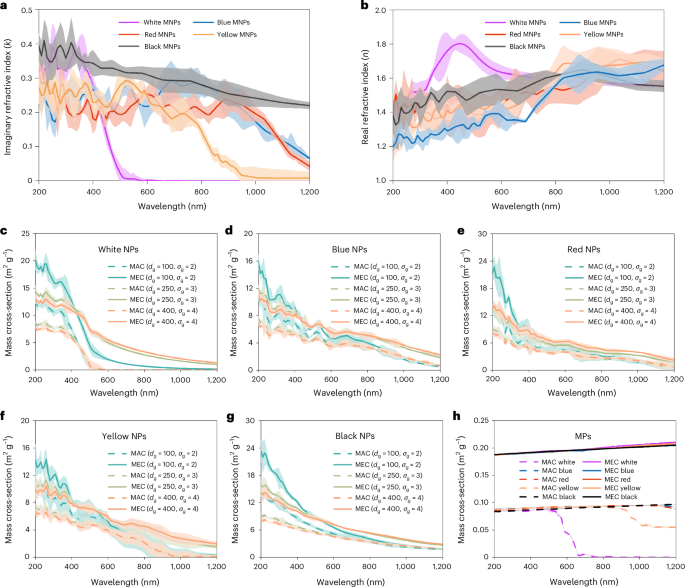
Microplastic and nanoplastic particles (MNPs) are pervasive in the atmosphere, yet their direct radiative forcing (DRF) remains poorly constrained. Using a radiative transfer model combined with experimentally derived optical properties and simulated atmospheric distributions, we show that coloured MNPs exhibit strong light absorption, with a mean refractive index of 1.49–0.22i at 550 nm and absorption coefficients 74.8 times higher than those of pristine particles. Atmospheric ageing produces minimal net optical change, as yellowing-induced absorption in white particles is largely offset by bleaching of red ones. Modelled global surface concentrations reach 4.18 MP m−3 for microplastics and 3.67 ng m−3 for nanoplastics. Resulting simulations yield mean DRF of 0.039 ± 0.019 W m−2 for MNPs, equivalent to 16.2% of black carbon forcing. Regional DRF peaks over the North Pacific Subtropical Gyre (~1.34 W m−2), exceeded located black carbon by 4.7-fold, highlighting MNPs as previously unrecognized climate forcing agents. The radiative impact of microplastic and nanoplastic particles in the atmosphere is not well understood. Here the authors quantify their radiative forcing, finding that they can exceed that of black carbon regionally. Thompson, R. C. et al. Twenty years of microplastic pollution research—what have we learned?. Science 386, 6720 (2024). Allen, S. et al. Atmospheric transport and deposition of microplastics in a remote mountain catchment. Nat. Geosci. 12, 339–344 (2... [7589 chars]


2026 Copyright © News-Matic.com. All Rights Reserved