


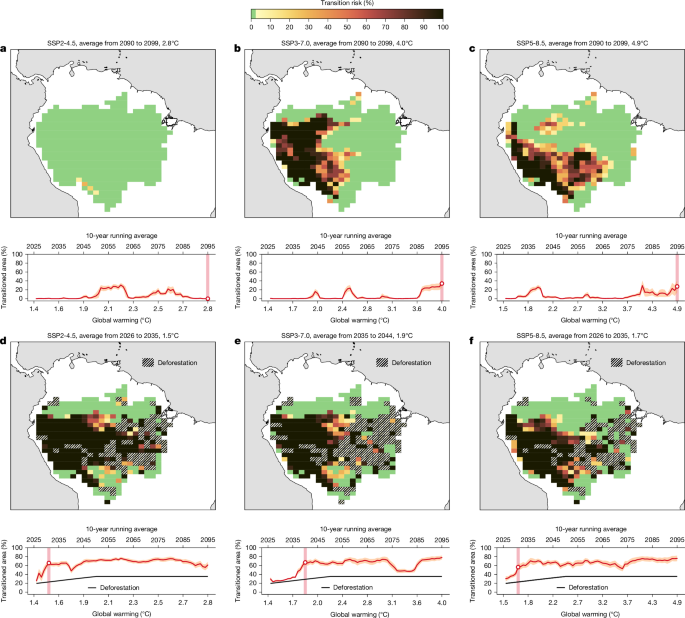
Humanity is putting unprecedented pressures on the Amazon forest system through global warming and land use changes1,2. As the Amazon forest may undergo self-reinforcing transitions, these pressures could lead to system-wide changes across major parts of Amazonian ecosystems1–4. Here we apply a dynamical systems model to assess the local and far-reaching cascading transition risks towards degraded ecosystems in the Amazon biome under different Shared Socioeconomic Pathways. For these emission scenarios, we constructed how moisture is transported through the atmosphere within the Amazon basin using an established atmospheric moisture-tracking model5. Without accounting for deforestation, we find a critical global warming threshold of 3.7–4.0 °C, beyond which up to a third of the Amazon forest risks losing stability. However, when considering deforestation, we find a near system-wide transition of the Amazon forest (62−77% of the area) under the combination of a lower threshold range of global warming of 1.5–1.9 °C and deforestation of 22–28%. The large majority of the simulated transitions is caused by spatial knock-on effects from increasing drought intensities, leading to long-ranging and self-propelling cascades on scales of hundreds to thousands of kilometres. Overall, our results reinforce the need to keep global warming levels below 1.5 °C and halt deforestation, as well as ecologically restore degraded forests to avoid high transition risks across the Amazon forest system. The Amazon forest faces a near system-wide transition of 62−77% of the area under a combination of 1.5–1.9 °C global warming and 22−28% deforestation. Globally, native biomes have been unprecedentedly threatened by anthropogenic activities and are already showing signs of decreasing resilience6,7,8. Among those endangered biomes is the Amazon forest, where increasing droughts, the loss of biodivers... [44239 chars]


2026 Copyright © News-Matic.com. All Rights Reserved