


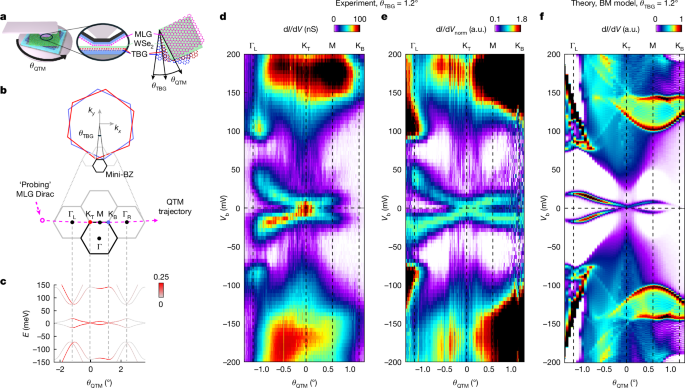
Electron interactions in quantum materials fundamentally shape their energy bands and, with them, the material’s most intriguing quantum phases. Magic-angle twisted bilayer graphene (MATBG)1–3 has emerged as a model system in which flat bands lead to a variety of such phases, yet the precise nature of these bands has remained elusive owing to the lack of high-resolution momentum-space probes. Here we use the quantum twisting microscope (QTM) to directly image the interacting energy bands of MATBG with unprecedented momentum and energy resolution. Away from the magic angle, the observed bands closely follow the single-particle theory. At the magic angle, however, we observe bands that are completely transformed by interactions, exhibiting light and heavy electronic character at different parts of momentum space. On doping, the interplay between these light and heavy components leads to a variety of notable phenomena, including interaction-induced bandwidth renormalization, Mott-like cascades of the heavy particles and Dirac revivals of the light particles. We also uncover a persistent low-energy excitation tied to the heavy sector, suggesting a new unaccounted degree of freedom. These results resolve the long-standing puzzle in MATBG—the dual nature of its electrons—by showing that it originates from electrons at different momenta within the same topological heavy-fermion-like flat bands. More broadly, our results establish the QTM as a powerful tool for high-resolution spectroscopic studies of quantum materials previously inaccessible to conventional techniques. Quantum twisting microscopy is used to directly image the interacting energy bands of magic-angle twisted bilayer graphene, allowing characterization of the dual nature of its electrons at the magic angle. Cryogenic QTM All measurements in this work were performed in a cryogenic QTM system operating at a temperature of 4 K, as described previously45. For conductance measurement, voltage biases are applied using a custom-built digital-to-analogue conver... [38763 chars]


2026 Copyright © News-Matic.com. All Rights Reserved