


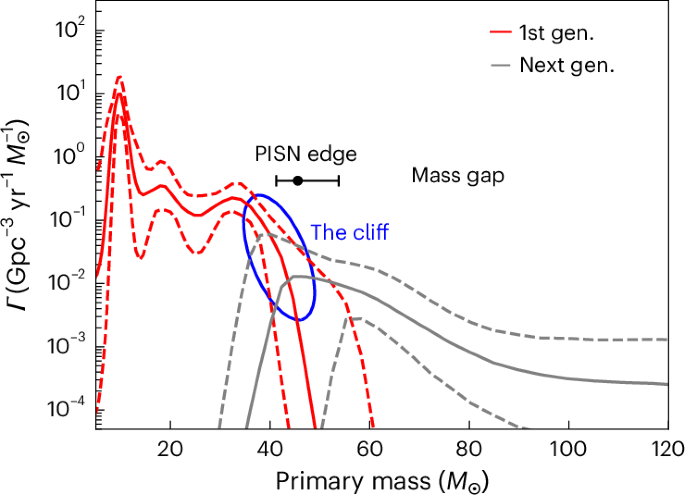
Pair instability should prevent the direct formation of black holes above about 50 M⊙, creating a ‘pair-instability’ mass gap. Yet gravitational-wave observations have detected black holes in this mass range. These systems can be explained with uncertainties in massive-star evolution, or hierarchical mergers in stellar clusters, which are expected to produce large spins with isotropic orientations. Here we present evidence for the pair-instability mass gap in the LIGO–Virgo–KAGRA fourth transient catalogue, with a lower edge at $$44.{3}_{-3.5}^{+5.9}\,{M}_{\odot }$$ . We also obtain a measurement of the 12C(α, γ)16O reaction rate, yielding an S-factor of $$26{8}_{-116}^{+195}\,{\rm{keV\; b}}$$ , a parameter critical for modelling helium burning and stellar evolution. The data reveal two populations: a low-spin group with no black holes above the gap, and a high-spin, isotropic group that extends across the full mass range and occupies the gap, consistent with hierarchical mergers. These findings are consistent with pair instability playing a role in shaping the black hole mass spectrum, point to a connection between gravitational-wave astronomy and nuclear astrophysics, and highlight dense stellar clusters as key environments in the growth of black holes. Gravitational-wave data reveal evidence for the pair-instability mass gap and a population of high-mass black hole mergers formed in star clusters. The measurement also constrains the nuclear reaction that regulates carbon–oxygen production in massive stars. Gravitational-wave observations of binary black holes have opened a new window onto massive-star evolution1,2,3,4,5, but population inferences remain hampered by uncertainties in binary physics and initial conditions (see, for example, refs. 6,7,8,9)... [29022 chars]


2026 Copyright © News-Matic.com. All Rights Reserved