

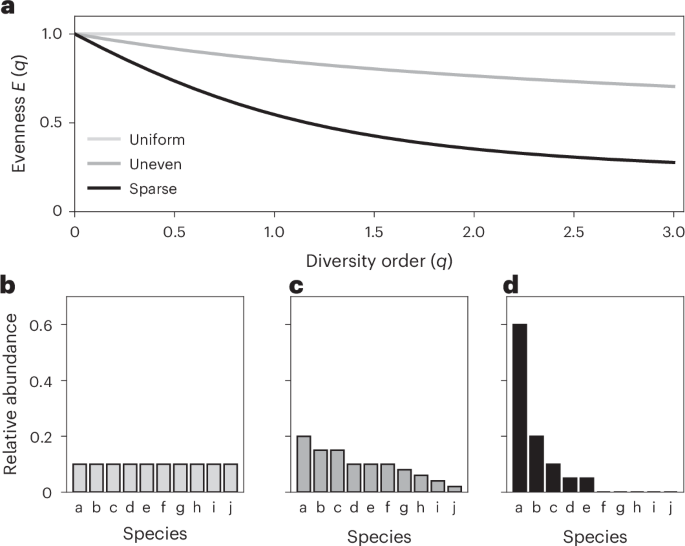
The search for life in the Solar System hinges on data from planetary missions. Detecting biosignatures based on molecular identity, isotopic composition or chiral excess requires measurements that current and planned missions can only partially provide. We introduce a new class of biosignatures, defined by the statistical organization of molecular assemblages and quantified using diversity metrics. Using this framework, we analysed amino-acid diversity across a dataset spanning terrestrial and extraterrestrial contexts. We found that biotic samples are consistently more diverse—and therefore distinct—than their sparser abiotic counterparts. This distinction also holds for fatty acids, indicating that the diversity signal reflects a fundamental biosynthetic signature. It also proves persistent under modelled space-like degradation. Relying only on relative abundances, this biogenicity assessment strategy is applicable to any molecular composition data from archived, current and planned planetary missions. By capturing a fundamental statistical property of the chemical organization of life, it may also transcend biosignatures that are contingent on Earth’s evolutionary history. The degree of diversity of molecular species within amino-acid and fatty-acid assemblages distinguishes biological from abiotic samples, suggesting that molecular distribution patterns could serve as a biosignature for detecting life beyond Earth. Deamer, D. W. Role of amphiphilic compounds in the evolution of membrane structure on the early Earth. Orig. Life Evol. Biosph. 17, 3–25 (1986). Klenner, F. et al. Discriminating abiotic and biotic fingerprints of amino acids and fatty acids in ice g... [10188 chars]
ADVERTISEMENT



ADVERTISEMENT
2026 Copyright © News-Matic.com. All Rights Reserved