


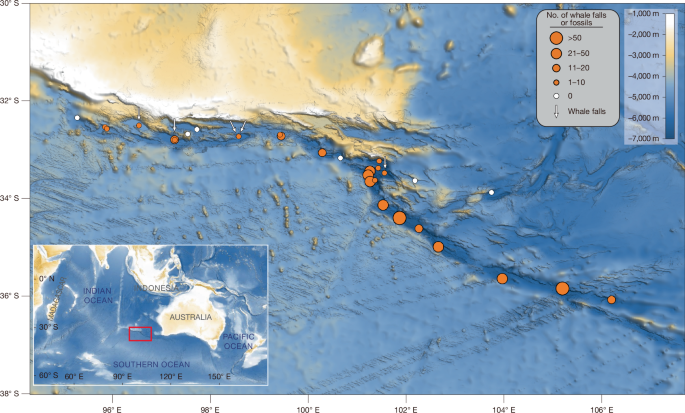
Whale falls are biodiversity oases at seabeds1–6, yet their record from the oceans has remained sparse and fragmentary6,7. Here we report the discovery of a vast whale necropolis in the Diamantina Zone (4,616- to 7,001-m depth), extending about 1,200 km along the sea floor of the southeastern Indian Ocean. This area has a deep and extensive accumulation comprising five modern natural whale-fall communities and 476 fossil cetaceans recorded. We show that carcasses host specialized communities dominated by brittle stars, bone-boring worms and chemosynthesis-based bivalves and that the fossil record in this area comprises both extant and extinct deep-diving beaked whales. Isotopic dating shows that whale falls in this region have occurred since at least 5.3 million years ago. These findings reshape the understanding of the limits and biogeography of whale-fall ecosystems and establish some deep sea floors as a fossil archive for tracing cetacean evolution over geological time. Researchers uncovered an enormous deep-sea accumulation of whale remains in the southeastern Indian Ocean, showing long-term, specialized ecosystems and an extensive fossil record that offers new insight into deep-ocean biodiversity and whale evolutionary history. The deep sea is home to myriad life forms that have adapted to extreme environmental conditions. One of the most fascinating phenomena of the deep sea are whale-fall communities, whereby a whale carcass that sinks to the ocean floor1,2,3 initiates a ... [21952 chars]
ADVERTISEMENT



ADVERTISEMENT
2026 Copyright © News-Matic.com. All Rights Reserved


