


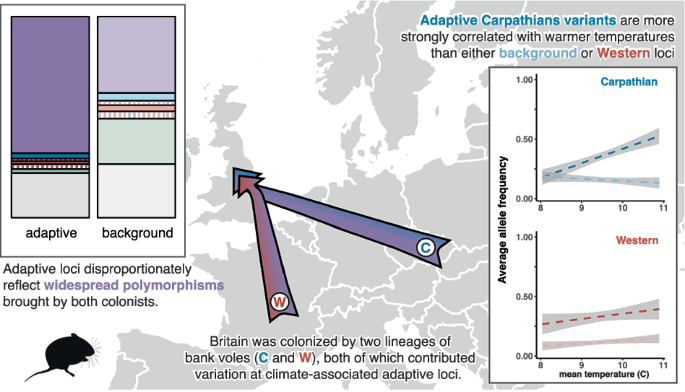
Population history is a key yet underexplored determinant of local adaptation. Here, we assess its role by inferring the geographic origin of alleles at climate-associated loci. Using whole-genome data from 151 bank voles (Clethrionomys glareolus) sampled in Britain and four mainland European source populations with ancestry representing the Carpathian and Western refugia, we evaluate the origins of SNPs linked to climate adaptation at 1074 candidate loci. Most SNPs at adaptive loci represent widespread polymorphisms, shared across both European refugia and Britain. However, the larger and older Carpathian refugium contributed more unique SNPs associated with climate adaptation, which are more positively correlated with high temperatures, compared to the smaller contribution of uniquely Western alleles. Together, these results demonstrate that local adaptation is shaped not only by shared ancestral variation but also the distinct evolutionary legacies of individual refugia. Tracing the origins of variation at adaptive loci in British bank voles reveals that most variants exist as widespread polymorphisms shared with Europe and maintained during colonization, with lineage-specific differences in climate associations. This study was supported by the Czech Science Foundation (Grant No. 20-11058S) and by a Ministry of Education, Youth and Sports of the Czech Republic (Grant No. LUAUS25009), both awarded to P.K. M.O.R.d.C was supported by an Adams Fellowship from the... [1252 chars]

ADVERTISEMENT

ADVERTISEMENT
2026 Copyright © News-Matic.com. All Rights Reserved