


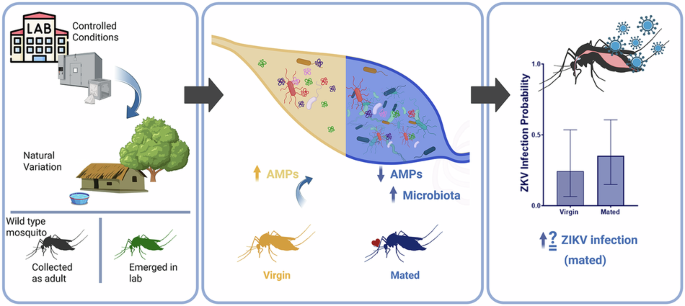
Mosquito reproduction and immunity hold tradeoffs that directly impact vector competence, yet the physiological mechanisms linking mating, immunity, and arbovirus infection remain poorly understood under natural conditions. We previously showed in laboratory strains of Aedes aegypti that mating induces gut growth, suppresses immune responses, and promotes microbiota expansion. Here, we extend these findings to field-collected mosquitoes. Mated females displayed significantly enlarged midguts compared to virgins. In gravid individuals, mating was associated with reduced expression of antimicrobial peptide genes (gambicin and attacin) and increased bacterial abundance. Laboratory-reared adults from field-collected immature stages exhibited the same mating-dependent patterns, confirming the robustness of this physiological trade-off across ecological contexts. Our results demonstrate that mating-dependent gut remodeling and immune modulation persist in natural populations, with a trend toward higher Zika virus infection probability in mated females, suggesting reproductive physiology as an underappreciated determinant of vector competence. Field-caught Aedes aegypti exhibit mating-dependent midgut enlargement and immune suppression, linking reproductive physiology to gut microbiota expansion and potentially affecting susceptibility to arboviruses such as Zika. The authors would like to thank the staff at the local unit of the Vector Control program of the Health Ministry of Guatemala, particularly Henry Ezquivel, for his valuable assistance in selecting the collection sites. Special thanks to Drs. Laura Ha... [1459 chars]
ADVERTISEMENT

ADVERTISEMENT
2026 Copyright © News-Matic.com. All Rights Reserved