


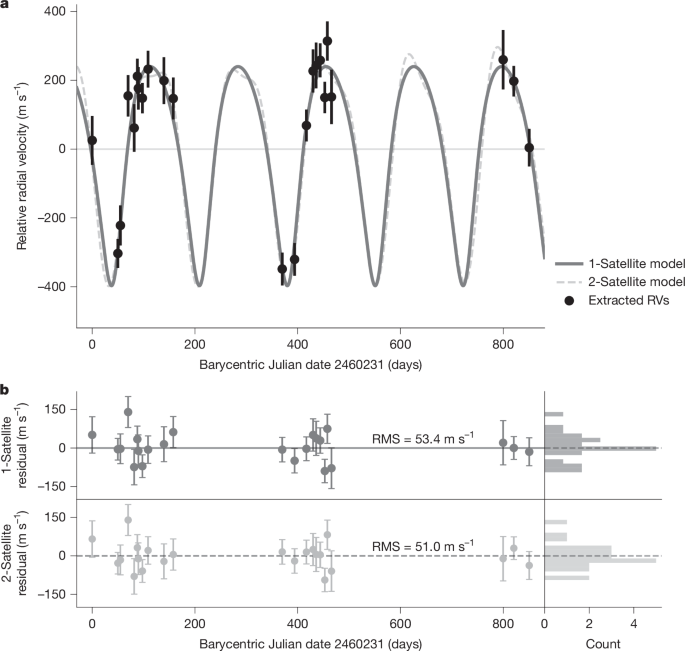
Brown dwarfs occupy the mass regime between planets and stars. In systems containing both a star and a substellar companion (be it a brown dwarf or an exoplanet), a third object orbiting the companion can be called an exosatellite. Exoplanet satellites can be easily described as exomoons, but it is not clear if satellites of brown dwarf companions can be called the same, as the term lacks a formal definition. Despite more than 6,000 exoplanets being discovered1, no exomoon has ever been confidently detected. Although there are candidates, they lack confirmation and remain controversial2–5. In this work, we present evidence of an exosatellite orbiting the directly imaged brown dwarf companion CD-35 2722 B. Applying radial velocity analysis, the same technique used to discover the first exoplanet around a Solar-type star6, to VLT/CRIRES+ spectra of this brown dwarf, we find what appears to be the periodic signal of at least one orbiting satellite. This is the first time, to our knowledge, this technique has produced evidence of satellites around a companion brown dwarf. Our best-fitting model includes a satellite with a minimum mass of about 0.9 Jupiter masses and a period of around 170 days. Although it is uncertain whether this exosatellite will fulfil the presently undefined criteria for qualifying as an exomoon, it is a marked step towards that first uncontroversial detection, as advancing technology will allow the same method to be applied to less massive targets. Radial velocity measurements provide evidence for a Jupiter-mass exosatellite orbiting the brown dwarf companion CD-35 2722 B, a promising detection of an exomoon-like object. Brown dwarfs occupy the mass regime between planets and stars. In systems containing both a star and a substellar companion (be it a brown dwarf or an exoplanet), a third object orbiting the companion can be called an exosatellite. Exoplanet satellit... [1245 chars]
ADVERTISEMENT

ADVERTISEMENT
2026 Copyright © News-Matic.com. All Rights Reserved


