


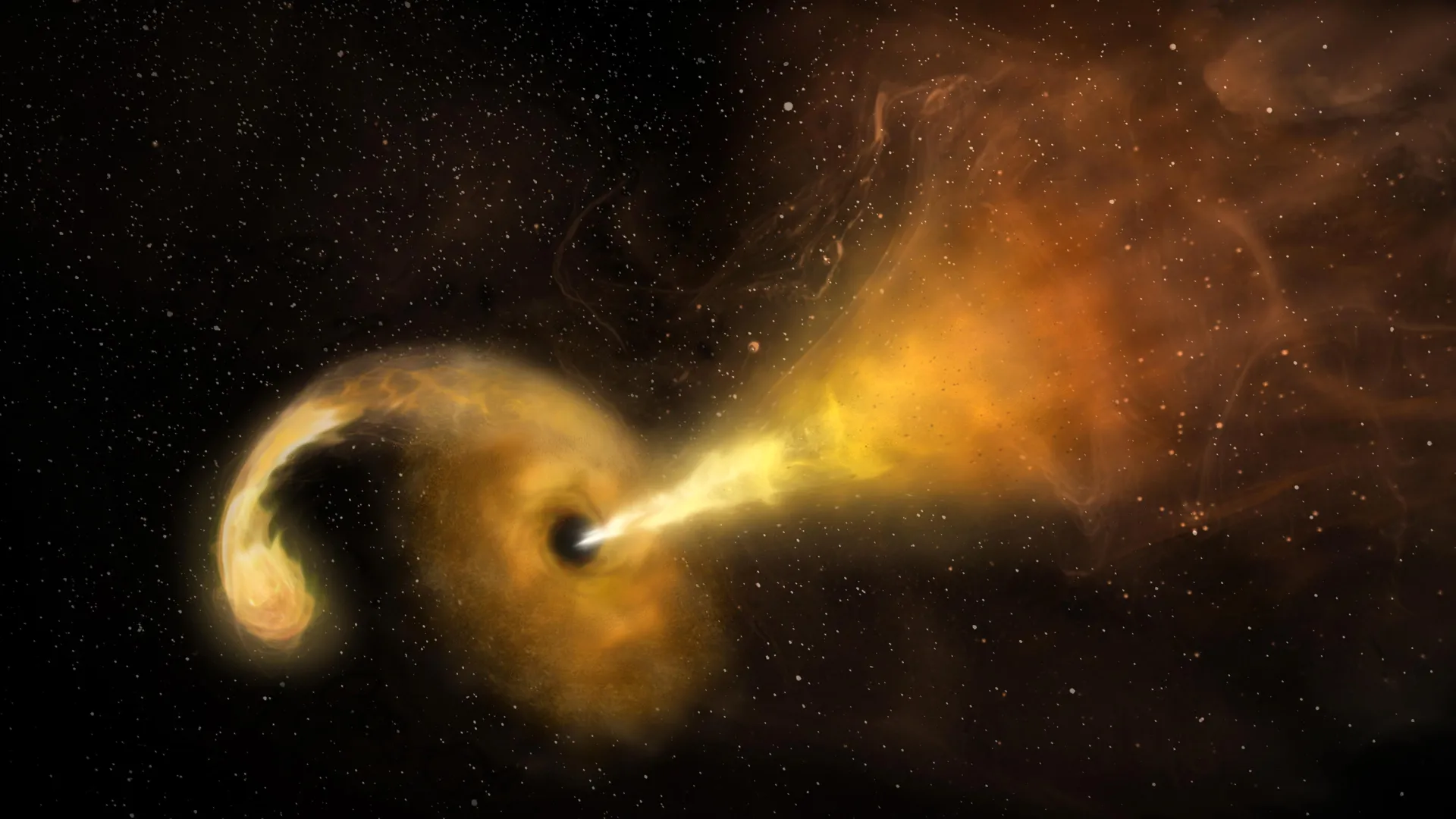
NASA’s Swift Observatory observed a supermassive black hole ripping apart a star more than 30,000 light-years from the center of a distant galaxy. The extraordinary flare briefly outshone its entire host galaxy in ultraviolet light and revealed a black hole about a million times the Sun’s mass. "We were looking for these star-shredding events as a way to find otherwise invisible supermassive black holes wandering away from the galactic cores where they usually reside," said Robert Stein, a research fellow at The University of Maryland, Coll... [6344 chars]
ADVERTISEMENT

ADVERTISEMENT
2026 Copyright © News-Matic.com. All Rights Reserved