


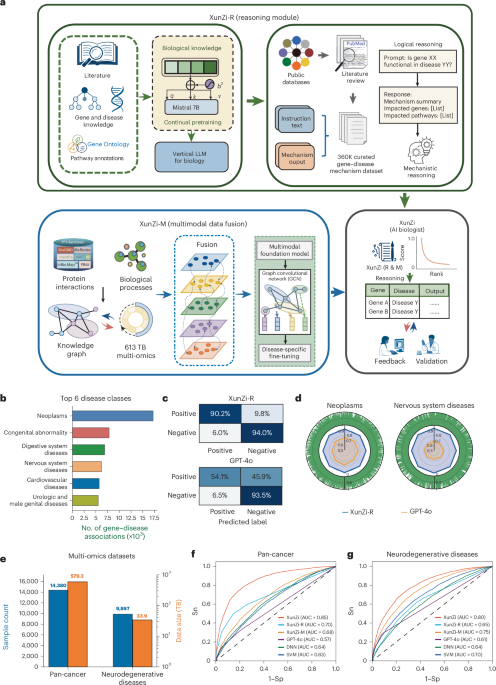
Hypothesis generation in biomedicine is constrained by human cognitive limitations in synthesizing insights from fragmented biomedical knowledge and multimodal data sources. Here we introduce XunZi, an AI biologist that integrates logical reasoning and multimodal data fusion to autonomously generate de novo therapeutic target hypotheses with testable mechanisms. XunZi has been trained on 24.4 million publications and 613.6 TB of multisource data spanning 21,008 human genes and 5,850 diseases, and outperforms existing methods in both accuracy and interpretability across diverse disease contexts. In Parkinson’s disease (PD), where complex mechanisms and limited targets hamper therapy development, XunZi identifies aberrant activation of CHK2 and IRAK4 kinases across multiple models. Pharmacological or genetic inhibition of Chk2 rescues dopaminergic neuron loss and motor deficits in PD mice. We further demonstrate XunZi’s broad versatility in diseases such as non-small-cell lung cancer. XunZi establishes a paradigm-shifting framework to translate fragmented biomedical knowledge and data into actionable therapeutics. XunZi is an AI biologist capable of synergizing logical reasoning and multimodal data fusion to generate de novo therapeutic target hypotheses. XunZi was used to discover two therapeutic targets in Parkinson’s disease that were subsequently verified. Glass, D. J. & Hall, N. A brief history of the hypothesis. Cell 134, 378–381 (2008). Tanford, C. Data and hypothesis. Science 146, 1635–1636 (1964). Ozanne, S. E. & Constância, M. Mechanisms of disease: the developmental origins of disease and the ro... [12927 chars]
ADVERTISEMENT

ADVERTISEMENT
2026 Copyright © News-Matic.com. All Rights Reserved