


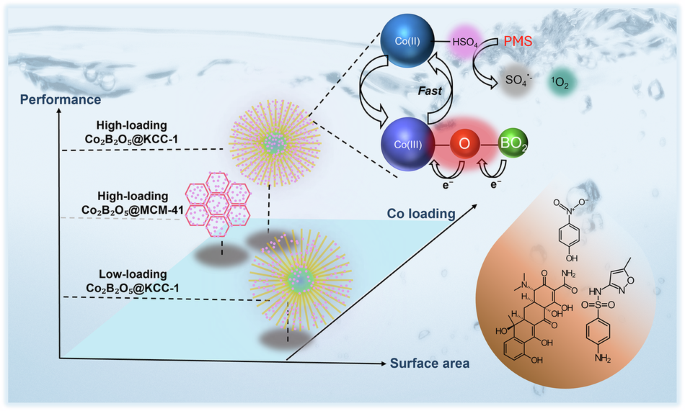
Sulfate radical (SO₄•⁻)-based advanced oxidation processes (SR-AOPs) offer high redox potential, long half-life, and superior selectivity for degrading persistent pollutants in wastewater. However, challenges remain in developing high-activity, recoverable, and reusable catalysts using non-noble metals. Here, we report a high-performance catalyst by immobilizing cobalt pyroborate (Co₂B₂O₅) onto dendritic fibrous silica (KCC-1), enabling efficient peroxymonosulfate (PMS) activation for degrading 4-nitrophenol (4-NP), tetracycline (TC), and sulfamethoxazole (SMX). The optimized Co₂B₂O₅@KCC-1 catalyst (Si/Co = 6, B/Co = 1.5) exhibited 1.6-, 1.9-, and 4.6-fold activity enhancements over CoₓOᵧ@KCC-1, Co₂B₂O₅@MCM-41, and one-pot synthesized Co–B@KCC-1, respectively, underscoring the synergistic benefits of the pyroborate phase and fibrous silica support. This enhanced performance stems from the synergistic integration of redox-active Co₂B₂O₅ with the high-surface-area, radially porous KCC-1 framework, which enables uniform dispersion, increased active site accessibility, and accelerated mass transport. Reactive oxygen species (ROS) trapping and EPR analyses confirmed the generation of surface-bound SO₄•⁻ and singlet oxygen (¹O₂), suggesting coexisting radical and non-radical oxidation pathways. XPS revealed dynamic Co²⁺/Co³⁺ redox transitions during PMS activation, while Bader charge analysis via DFT showed that borate ligands reduce Co electron density by ~0.16 |e| relative to Co₃O₄, facilitating redox cycling. The catalyst exhibited excellent reusability, structural integrity, and retained activity in natural organic matter-rich and river water matrices. This work establishes a foundational platform for high-loading cobalt borates immobilized on fibrous supports, offering a scalable and robust solution for the catalytic degradation of emerging contaminants via sulfate radical-based AOPs. The persistent release of organic pollutants like pharmaceuticals into water bodies poses significant environmental challenges, as conventional wastewater treatments often fall short in degrading these substances. This study explores the development of cobalt pyroborate catalysts supported on dendritic fibrous silica (KCC-1) for advanced oxidation processes (AOPs). The authors employed both one-pot hydrothermal and post-synthetic impregnation methods to synthesize Co₂B₂O₅@KCC-1 catalysts, varying Si/Co and B/Co molar ratios to optimize phase composition and morphology. The optimized catalyst demonstrated superior degradation of pollutants such as 4-nitrophenol, tetracycline, and sulfamethoxazole, attributed to the formation of phase-pure Co₂B₂O₅ with favorable redox properties. The study highlights the catalyst’s high reusability and stability, suggesting its potential for practical wastewater treatment applications. Future work could focus on further enhancing the catalyst’s performance and reducing cobalt leaching. This summary was initially drafted using artificial intelligence, then revised and fact-checked by the author. High-loading Co₂B₂O₅ supported on dendritic fibrous KCC-1 exhibits enhanced catalytic performance by integrating favorable Co₂B₂O₅ redox chemistry with accessible active-site dispersion and efficient mass transport. The Co(II)/Co(III) redox cycle promotes PMS activation and reactive oxygen species generation for the degradation of diverse organic pollutants. Comparative studies with MCM-41-supported and low-loading catalysts demonstrate that catalytic performance is governed by the combined effects of active-phase identity, cobalt loading, spatial distribution, and support architecture rather than surface area alone. Open Access This article is licensed under a Creative Commons Attribution-NonCommercial-NoDerivatives 4.0 International License, which permits any non-commercial use, sharing, distribution and reproduction in any medium or format, as long as you give... [797 chars]
ADVERTISEMENT

ADVERTISEMENT
2026 Copyright © News-Matic.com. All Rights Reserved

